July 9, 2007

Try this. It's good.

A friend and I once had a debate over whether "Italian" food--like that served at V&T and Olive Garden--in the United States should be considered Italian or American at heart. He argued that since the basic ingredients (pasta) and ideas (tomato sauce) were inspired by Italian cuisine, it should be the former. I disagreed--pouring tomato sauce into a pot of drained spaghetti is a distinctly American idea. In any case, if the basis of our food taxonomy is whatever culture "inspired" it, then Italian cuisine would also have to include bologna, which is about as Italian as it is wholesome.

JAF, I doubt you read this blog, but one day you will see that you're wrong. About everything. Always.

Anyway, making pasta really delicious requires a different technique than simply dumping sauce on steaming noodles. In general: While cooking pasta in salted boiling water, add either butter or olive oil to a pan over medium heat. Add aromatics, and, if using, meat. Let cook. Add vegetables, salt, and pepper. When vegetables are almost cooked, add cooked pasta with a little bit of pasta water. Mix contents of pan (two goals here: spread flavors and emulsify starchy pasta water with butter/EVOO to make a sauce). Add chopped herbs. Sprinkle with cheese. Gloat.

As you can see, there's a lot of flexibility with the ingredients, but in general you always use some type of fat, salt, and pepper. Good combos:
Butter, sage, pancetta, and peas.
Butter, pecorino cheese, pepper.
Olive oil, garlic, tomato, basil.
Olive oil, shallots, and pecorino.
Olive oil, sausage, broccoli rabe, spinach.

Also: How to eat pasta

July 7, 2007

BREAD :-)

Hurrah for food reincarnation! Just as each culture has it's own version of life after death, each culture also has it's own way of using old carbs. The American kitchen makes stuffing and french toast; the Chinese kitchen fried rice and juk; and the Tuscan kitchen pappa di pomodoro and panzanella.

I find these dishes' English translations hilarious, because pappa di pomodoro will be soup and panzanella salad only when stuffing--their culinary second cousin--falls into either category. All three foods have similar textures, which means the "Tuscan bread soup" lacks broth and the "Tuscan summer bread salad" is scant on vegetables. I prefer the latter to the former, but will sadly be unable to genuinely replicate either once I get home. Unsalted bread is difficult to find outside of Tuscany, and--more problematic--carb populations, no matter how large, often go extinct within 24 hours of entering my kitchen. Anyway, both dishes are delicious, Tuscan ways to recycle old bread.

The other delicious, Tuscan way to recycle old bread is to feed it to the chickens out back.
And then eat their eggs.
And then eat them.

----

Pappa di Pomodoro
- Saute chopped onions in olive oil. Add chopped basil. Add 1 part pureed tomatoes and 1 part water. Cook over medium heat for 18 minutes. Add pieces of stale bread slowly until bread absorbs all liquid. Mix until pieces of bread are smaller, but do not make into a paste. Add salt and pepper. Serve drizzled with olive oil.

Panzanella - Soak stale bread in water until fully saturated. Squeeze water out and rip bread into small pieces. Add chopped onions, tomatoes, and cucumbers. Mix. Add salt, pepper, and olive oil liberally. (Carb:Veggie ratio should be similar to that of fried rice).

July 3, 2007

Consultants are smart!

Bosses urged to watch more movies: Four Italian management consultants have come up with a novel way to get ahead in business - read fewer textbooks and watch more films. (BBC)
Excerpt: "Lolita, Stanley Kubrick's 1962 offering, contains "lessons about seduction and betrayal" which might be useful for investing on the stock market"

July 2, 2007

Out-run and out-eaten

After the Notturna di San Giovanni, a 10K in Florence, I left thinking four things:
- Running in Italy is like driving in Italy. There must be rules, I just don't’ know what they are.
- Clocks in Italy are like Saints. These days, their utility is aesthetic.
- Thank God Vivoli stays open until 11PM.
- Racing in Italy can’t get any better than this—what other race will start with a parade (men in tights throwing flags), feature a vocal crowd, and offer views of half the curriculum of Art Hum?

I reconsidered the last point at the finish of a 7-point-something K near Siena, where they gave each participant a bottle of wine. I chuckled to myself and began to think about how my friends would react when I told them this once I got home.

We didn’t go home. Ubaldo had indeed kept his promise to take me with him to races, but, here in Tuscany, “race” also means “dinner” (which is proceeded by a “post-race shower” and followed by “drinks”).

Fast forward to the food: Walking toward the dinner tent, I heard my name. The race organizers were conducting a raffle among participants, and I had won a chocolate pastry! All the participation prizes were food—olive oil, salami, good wine, sweets.

We waited in line to order and get a table. An eight year old served beer on tap, while his mother managed the cash register. As we sat down, one of Ubaldo’s friends uncorked his raffle prize (DOCG olive oil) and poured it over bread for the table. Half a wheel of pecorino rosso appeared (origins: unclear). Then, finally our order: a crostoni platter. Beer. Prosciutto and melon. Pici with ragu. More beer. Mushroom and prosciutto pizza. A pork chop. Orange pastry. By this time, the Italians—most of whom had run sub 2:40 marathons in the last two weeks—started to smoke and speak quickly in dialect. Another round of beer. I checked the time; it was 1 AM.

“Don’t worry,” Ubaldo’s wife whispered to me as she surveyed the mess. “I’ll drive.”

June 19, 2007

Siena, and more white meat

Part I: Siena - Although Ambra is near many well-known Italian areas (Florence, Arezzo, Chianti), it's really a culinary satellite of Siena.

Here in the countryside, Siena seems to be regarded with a mix of reverence ("bella, bella, bella!") and indignation ("They think they're the center of the universe. That's just how they are."). A few thoughts on my visit:

* The view from the top of the Facciatone is, unlike most towers, not just a way for locals to chuckle at tourists waddling up the staircase. Tuscany's strict building codes have served the city well in preserving a gorgeous landscape.
* Siena has historic quarters that, like cubicle clusters at Bain, have their own colors and mascots. Mascots ranged from eagles and dragons to snails and scallops. Go bivalves!
* The Lord of the Rings movies misrepresented lambdas bread in making it look like a flat empanada. A cake only in shape,
Panforte di Siena is the real thing. Eating a piece feels like eating three power bars. Or getting punched in the stomach.
* The bus system in Italy is a pain (we missed our bus and had to wait 4 hours), but fortunately there is no stigma attached to ordering prosecco at 4:00 in the afternoon. (There may be one attached to ordering two in quick succession, but oh well. It had been a long day.)

Part II: Dinner - After returning from Siena, we went to the butcher shop to buy meat for dinner. We selected a package of chicken drumsticks with the intention of sautéing them with pasta.


Hindsight: If the shop sells whole chickens with feet still attached, it's unlikely that they also sell packages of drumsticks.

Each drumstick was in fact a bird about the size of two fists, the species of which is still unclear. It was most likely pigeon though another contender is woodcock.

"See? This is maturity. I'm looking at this and laughing... Haaaaah." Since I was unsure of how to cook hearts and other organs, we removed the meat from the bodies. We dipped the poker-chip sized breasts in egg, dusted them with flour, and sauteed them with shallots and olive oil. They were a tasty entree, though I'm sure there's a better way to enjoy them. Whatever they are.

June 16, 2007

Bedtime stories for dinner

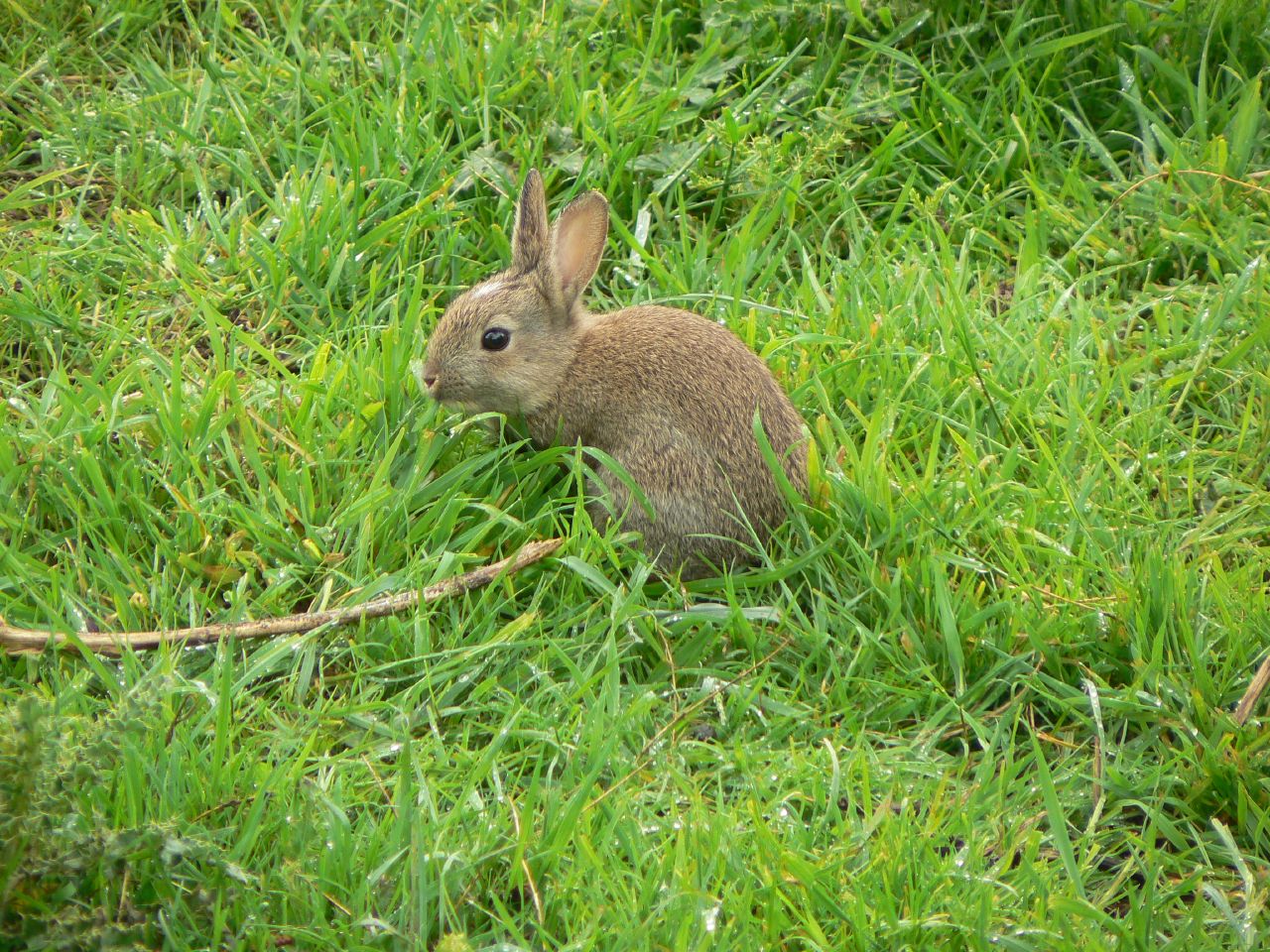
Adam Gopnik's discussion of food in literature* and one of this week's new dishes made me think of my sister's favorite bedtime story:

ONCE upon a time there were four little Rabbits, and their names were Flopsy, Mopsy, Cotton-tail, and Peter. They lived with their Mother in a sand-bank, underneath the root of a very big fir tree.

"Now, my dears,'' said old Mrs. Rabbit one morning, "you may go into the fields or down the lane, but don't go into Mr. McGregor's garden: your Father had an accident there; he was put in a pie by Mrs. McGregor.''
A fan of neither savory pies nor Potter-era English cooking, I maintain that had Peter been Pietro, he would've lost his brass buttons to avoid becoming a much tastier dish:

Braised bunny
Ingredients: rabbit, olive oil, leeks, celeriac, garlic, flour, salt, pepper, white wine.
Heat olive oil in a pan. Add chopped leeks (green part), celeriac, and garlic. Add quartered rabbit, dredged in flour. Let brown. Add salt and pepper. Add white wine (until almost covered) and let it simmer on the stove for about an hour and a half.

By the way, to all you poultry-eating vegetarians out there, rabbit is white meat.

* Thanks, Elise!

Photo credit: Mark Bridge
Original caption: "Cute enough to eat (but not quite large enough)"
http://flickr.com/photos/markbridge/147757763/